
Archive for 2011
Book Review: Innovation and Entrepreneurship in the Healthcare Sector
March 21, 2011
 This volume by Luis Pareras, MD, published by Greenbranch Press, is one of the most comprehensive works on the topic to date. The book is filled with tables and diagrams on a range of topics covering innovation and bringing innovations to market. The eight sections cover: principles, the healthcare sector, structuring the idea, pushing our idea forward, creating a stratup, venture capital, basic skills, and trends. By beginning with the healthcare value chain, the author lays the basis for innovation and identifying the rich opportunities in this market. Information is covered along with drugs, devices and biotech. Healthcare IT is also put in the context of the value chain with such categories as, reducing friction in transactions, extracting the knowledge component from the system and extending the scope of the relationship between physician and patient, also known as participatory medicine. The concepts of ehealth and Web 2.0 are addressed avoiding the more specific terms, Medicine 2.0 and Health 2.0 and the book stays true to covering topics in an objective, business oriented approach without making claims about where these areas should go. Providing a “Framework for Analysis” puts the health IT initiatives in context of the value chain.
The sections on creating a startup and venture capital could be true for any entrepreneur but do give specific advice to the healthcare entrepreneur, such as, knowing the audience you are addressing and if it is venture capitalist, do not assume they will know the details of your medical intervention or product. Discussing skills like negotiation help lay out specific steps in knowing and enhancing your position whether negotiating a partnership or a buyout.
The book can be used for many audiences – obviously the healthcare entrepreneur would benefit from this book as a reference volume to go to at specific stages of building a startup. The book could easily be the basis of an MBA course on the topic. Those considering moving an innovation into the healthcare market should read it with an understanding of what they are venturing into. Venture capitalist could benefit from understanding the healthcare value chain and how specific innovations target specific steps in that chain. Healthcare executives should consider reviewing this book for understanding the how innovations impact their day-to-day operations and better evaluate the innovations and new products presented to them.
Innovation in healthcare is pervasive, the opportunities are broad. Participating in this innovation needs a toolkit like this book. Is it worth the cost – to many of the groups mentioned above, definitely.
Share this:

Report from AMIA – All Diseases will become Orphan
March 12, 2011
The first speaker I heard at the American Medical Informatics Joint Summit was Kenneth Buetow from the National Cancer Institute. In his typical provocative manner, he challenged the audience on the transition day from the Translational Bioinformatics to the Clinical Research Informatics Summits. He began with promoting the P4 Medicine as the new model for healthcare: personalized, predictive, preemptive, participatory. Although throughout the conference little was articulated on the participatory aspects with one exception. More on that later.
Buetow talked about defining cancer on the molecular level and the challenge of the exponential number of patients required to do genetic screening for a single disease. He referred to Pharma 3.0 from the Ernst and Young report on Progressions 2011 where patient engagement through social media as necessary in this new age of medicine. It is here that he stated, “All diseases will become orphans” meaning that as we understand more about genomics and are able to combine these findings with clinical data, we will understand each disease process on a truly personalized level and hopefully treat it as such.
As part of Pharma 3.0 and a new model for medicine, he did note some encouraging trends in volunteers for clinical trials, true patient activism in a full participatory sense. Specifically, he reported some recent statistics from Army of Women, a joint project of Avon and Susan Love to recruit an army of those willing to volunteer for research studies. Rapid recruitment occurred consistently for studies through this resource while traditional clinical trials continue to suffer from lack of full enrollment. He also referred to adaptive clinical trials as part of this new model. Finally, he discussed the Translatable Informatics Ecosystem as a way of describing how informatics will be key in this new paradigm using Services-Aware Interoperability Framework (SAIF) as one technology to reach that goal.
Many of the presentations at this year’s conference were focussed on data warehouses of clinical and genomic data and ontology development and application include many efforts in the semantic space.
Several speakers referred to Evidence Based Medicine, Personalized Medicine and the Learning Healthcare System implying if not explicitly stating that there is a convergence of the future of medicine and that medical informatics and clinical research informatics are at the center of this convergence. Bill Hersch, noting the explosion of data both in journals and through EHRs and others sources, citing Stead on the need for “Systems of Brains” to manage the amount of information now available
All agreed that Medical Informatics is at a crossroads and has the opportunity to take leadership in the future of medicine, managing the data explosion and making it managable in the personalized medicine era we are entering.
Share this:American Medical Informatics Association – Clinical Research Informatics Summit
March 7, 2011
Heading to San Francisco for this AMIA meeting. Looking forward to the opportunity to present from the podium and poster session. Topics include:
- Development and Sustainability of an EHR-based Chronic Kidney Disease Registry
- REDCap – Characterizing the Rapid Adoption at a large Academic Health Center
- Design of a Registry Management Tool for EMR Data
- Research Recruitment in Anesthesia Using EMR Data
There will be many opportunities for networking. Hope to come home with lots of ideas.
Hash tag is #TBICRI11
Share this:HIMSS 11 Meaningful Use – The Spirit of the Regulation
March 6, 2011
A nice interview with Dr. Harris, CIO of the Cleveland Clinic and President of the HIMSS board on following the spirit of meaningful use, not just the letter of the regulation to create a real sea change in health care.
From Hospital and Health Networks Daily blog.
Social Media at HIMSS
February 27, 2011
Meet the Bloggers: Provider EditionI had the privilege to present three times at HIMSS11 on social media, twice at the social media center and twice on panels. My presentation at the social media center, Social Media in Health IT: Rapid Dissemination and Collaboration was brief but well received.
A Social Media Panel | Provider Edition: with David Kibbe and John Marzano was moderated by Rich Elmore was a great opportunity to interact and compare notes on social media and blogging. It was recorded -
The Meeting the Bloggers panel on Wednesday was well attended and worked well. The talented panel included
@ahier @cthielst @microsoftmd @dleyva08 .

We received a very positive review by iMedExchange titled “To Blog or Not to Blog.”
Thanks to Ceasar Torres and his team who did a great job at the HIMSS 11 Social Media Center. He even got his own interview
Overall, a great experience. Will post more about HIMSS in the next few days.
Share this:First Day at HIMSS 11
February 21, 2011
The two highlights of my day were the HIT X.O track and the Social Media Center.
HIT X.O: Beyond the Edge is a new track to predict and discuss the future of Health IT. Beginning with a presentation of the dozens of statistics and predictions on the future of wireless and ended with the Geeks Got Talent brief demos and judges going at it. The multimedia experience was unique as was the live tweets at the bottom of the dual screens. The next stage of the competition continues tomorrow.
The social media center is expanded this year, with an afternoon of presentations. I was glad to be on a panel with Rich Elmore, David Kibbe and John Marzano this afternoon. John’s Orlando Health Facebook page and complimentary YouTube channel are a great example of what hospitals can do with social media. We fielded questions from the audience via twitter – a good range of queries about everything from participatory medicine to risks and opportunities in health care social media. I enjoyed the Social Media Center as a welcoming environment with an opportunity to meet many I follow on Twitter. Thanks to Ceasar Torres and other HIMSS staff in making it a welcoming place.
Tomorrow I speak about my experience with using Twitter to connect with Health 2.0 and health IT colleagues.
The twitter stream at HIMSS was very active today demonstrating a greater adoption by both attendees and vendors.
Share this:On the Bookshelf
February 13, 2011
While I read The Myths of Innovation as an eBook, my next three are all paperbacks:
- Reading in the Brain: The New Science of How We Read by Stanislas Dehaene
- Innovation and Entrepreneurship in the Healthcare Sector: From Idea to Funding to Launch by Luis G. Pareras, MD
- Keys to EMR/EHR Success: Selecting and Implementing an Electronic Medical Record by Ronald B. Sterling.
The last two are Greenbranch Publishing.
Watch for book reviews in the near future.
Share this:Book Review – Myths of Innovation
February 12, 2011
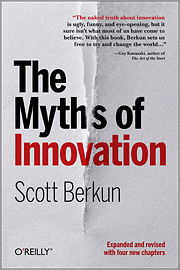 This new book from O’Reilly Media appears to be yet another book that attempts to cover the topic of innovation but does a better job than most of defining the myths and truths of innovation historically. The author proposes that eureka moments don’t happen, and rather “there is a period of incubation in which the knowledge is digested, leading to experiments and rough attempts at solutions.” And “Nearly every major innovation of the 20th century took place without claims of epiphany.”
In discussing the history of innovation, he notes that examples like Gutenberg whose influence was not felt until after his death. The history of innovation was not straight line of successes but rather as many failures and setbacks and often governed by political and social circumstances. He notes when you really dissect the evolution of innovations that “invention and adoption is based on ordinary, selfish, and mostly short-term motivations.”
If there is a formula for innovation, it includes hard work and persistence, curiosity, the desire for wealth, and necessity. So proceeding in innovation requires: finding an idea, developing a solution, sponsorship and funding, scaling, reaching customers, beating competitors, timing, keeping the lights on. At the same time, he notes, there can be infinite paths to innovation as recent history has shown whether looking at Flickr, 3M or Craig’s List. He also destroys the myth of the lone inventor.
The books also deals with barriers to innovation, the main one’s being negative responses like “this will never work” and the fact that managers tend to stifle innovation. “Ideas need nurturing and are grown, not manufactured, which suggests that idea shortages are self-inflicted. It doesn’t take a genius to recognize that ideas will always be easier to find if they’re not shot down on sight.” Managers can be toxic to new ideas. “high experience and confidence make people the greatest resisters to new ideas as they have the most to lose.” Maybe this is why some innovators leave large organizations and start their own companies. The good news is that managers can nurture innovation by protecting and shepherding them. Framing ideas can help solve them – especially when thinking through how the innovation will solve a practical need.
The book concludes by trying to get beyond the hype of which there is more today than any time in history. Innovators of the past did not read books about innovation or attend TED conferences, although some may have been inspired by other innovators in history. Innovations requires the willingness to take risks, working with teams, get beyond the obsession with epiphany, and get beyond the work innovation.
In conclusion, he gives five suggestions:
- Pick a project and start doing something
- Forget innovation: focus on being good
- If you work with others, you need leadership and trust
- If you work with others and things are not going well, make the team smaller
- Be happy about interesting “mistakes.”
The book also has suggestions for creative thinking hacks.
Overall, the book not only debunks many myths about innovation but also provides practical advice. For me the chapter on how managers can either inhibit or promote innovation. This is where innovation either grows or dies. For healthcare, the opportunities for innovation are everywhere in the care process if they are not blocked by managers or oppressive policies and oversight. The book does not address adequately the use of internet tools in promoting innovative ideas. These include Twitter, blogs,
Share this:
Innovation and Social Media at HIMSS
February 11, 2011
HIMSS emphasis on social media has grown every year. From a humble meeting of bloggers at a bar several years ago, to a social media center on the exhibit floor this year. Quite a change. I have the privilege of presenting 3 times at the social media center – providers panel on Monday, a solo presentation, Social Media in Health IT—Rapid Dissemination and Collaboration, and a meet the bloggers on Wednesday another Meet the Bloggers panel. Plan to join the tweet-up as well and tweet throughout using the #HIMSS11 hash tag.
On the innovation front, I helped plan the HIT X.O track which is new to HIMSS this year. Thinking from the future will stretch everyone’s thinking. Covering everything from futuristic mobile apps to personalize medicine in the next 10 years and military technology in healthcare, each session looks to be exciting.
See you there!
Share this:WebMD vs. MayoClinic.com – Reliable Medical Information
February 6, 2011
In an article in the New York Times Magazine today, Virginia Heffernen discusses a Prescription of Fear. She contrasts the WebMD approach to health information with that of MayoClinic.com, opposing what she sees at a for-profit website with major funding from drug companies on the one hand with a respected non-profit medical institution on the other. In comparing the two sites on the topic of headache, for one thing, she uses a Google search to find content on the sites rather than the sites own search engine and then claims that one has advertising and drives uses to prescription usage while the other does not.
I tested this with the term Fibromyalgia. It turns out that both sites display an add from Pfizer on the landing page, MayoClinic also has ads by Google but WebMD did not. WebMD on its chapter on treatment includes 3 brand name drugs but also recommends physical therapy and medical marijuana. MayoClinic recommends lifestyle and home remedies, alternative medicine and coping and support but nothing about drug therapy.
MayoClinic advertising policy states that “we accept advertising and sponsorship under strict guidelines” but does not state whether they have any control over the Google ads appearing on their pages. WebMD’s policy is extensive and states “under no circumstances will WebMD’s acceptance of any Advertisement be considered an endorsement of the product(s) and/or service(s).” Both sites are HON Code certified and WebMD also has eTrust and URAC shields.
So there may be something to WebMD suggesting drug treatment more often that MayoClinic, but the article fails to mention that MayoClinic.com is supported by advertising and in some cases has more ads per page than WebMD.
It should be noted that other medical institutions do not use advertising but provide reliable medical information from their own sources such as, Duke and Cleveland Clinic .
Share this: