
Posts Tagged ‘EMR’
New Publication: Chronic Kidney Disease in an Electronic Health Record Problem List
April 2, 2014
Full title is, “Chronic Kidney Disease in an Electronic Health Record Problem List: Quality of Care, ESRD, and Mortality” published in the American Journal of Nephrology. It has implications for CKD but other chronic conditions as well regarding the appropriate use of problem lists in the EMR. With CKD, diabetes and other chronic conditions which can be initially diagnosed with a lab test (eGFR for CKD), early identification is possible. But if the patient is not formally given the diagnosis in the problem list, it may lead the lack of early preventive care which can slow the progression of a chronic illness.
On another note, I am also actively blogging for HIMSS and posting blogs from HIMSS volunteers. Check out the HIMSS blog.
Share this:
Data Mining, Algorithm Medicine and Skeptics
February 21, 2013
My recent Perspective on iHealthbeat focused on the uses of data mining of EMR data which are yet to be fully exploited. My thoughts were provoked by a New York Times article titled, Mining Electronic Records for Revealing Health Data. Although data mining in healthcare has gotten a bad reputation, an approach which respects privacy and a focus on research discovery can yield important results. The potential uses of EMRs in research is another opportunity yet to be realized.
A new article in The Atlantic, The Robot Will See You Now, discusses IBM Watson and other initiatives moving medicine toward what I call Algorithm Medicine and Artificial Intelligence. The potential of mining EMRs to generate real-time clinical decision support has exciting possibilities. However, there are skeptics, especially when the predictions expand to entertain the idea of replacing physicians. Realizing the limitations of technology must be acknowledge. For instance, the concerning problem of copy-and-paste in EMRs would have a negative affect on data mining those records. Also, data mining has presents real challenges both in defining research questions and finding the correct data to answer those questions.
So data mining shows promise but a realistic approach without wild predictions can lead to real discovery and impact on practice.
Share this:
Presentation at H2.0 Hospital Liquido Barcelona, June 12
June 14, 2012
Electronic Medical Records: From Clinical Decision Support to Precision Medicine
With an emphasis on lethal lag time and how EMRs can be used to bring new discoveries to medical practice more quickly.
Share this:Presenting at H2.0 Hospital Liquido Barcelona, June 11-12
June 7, 2012
The themes of this conference, lead by Jorge Juan Fernández García, are:
- H ealthcare / Medicine
- I nnovation
- T echnology
- E ntrepreneurship
Algorithms in Medicine
February 14, 2012
Algorithms have a growing place in medicine. There are at least two kinds of algorithms – practice guidelines and predictive.
Practice guideline or best practice algorithms may emerge out of practice-based research or consensus panels which recommend specific practices to improve care. One example relates to algorithms in intensive care. Cleveland Clinic has excellent examples on their medical education website which include everything from weaning to acid-based disorders. Some may criticize this as “cookbook medicine.” But with the complexity of care, especially intensive care, these kind of algorithms should be welcome. How these can be integrated into clinical decision support in electronic medical records is yet to be fully realized.
Predictive models, on the other hand, use patient-specific data to determine future risk of disease or risk. Predictive models are usually based upon large data sets and in recent years that means EMR data. A couple of examples:
- Predicting 6-Year Mortality Risk in Patients With Type 2 Diabetesby one of my colleagues
- Development and Validation of a Predictive Algorithm to Identify Adult Asthmatics from Medical Services and Pharmacy Claims Databases
- http://prostatecancerinfolink.net/tips-tools/kattan-nomograms/ by another colleague
- nomograms.org
Share this:
Book Reviews: EHRs
February 6, 2012
I recently read two books on EHR/EMRs: one was published in 2007 but still has relevance, the other published in 2010 and focused on implementation.
 Electronic Health Records: A Guide for Clinicians and Administrators by Jerome Carter is published by the American College of Physicians is a 500+ page volume written primarily for physicians. The first part of the book is a comprehensive review of EHRs including infrastructure, perspectives on the the use of EHRs for things like outcomes, clinical decision support and quality improvement and legal and privacy issues. The second half of the book is devoted selection and implementation of EHRs with a comprehensive workbook on product features and vendor selection. The majority of the book is still highly relevant with the only exception being some of the information on infrastructure which seems outdated and the lack of discussion of mobile uses of EHRs which is definitely a future goal.
The second book, Keys to EMR/EHR Success: Selecting and Implementing an Electronic Medical Record is also in its second edition. This work by Ronald Sterling begins by walking the reader through the initial questions of why invest in an EMR and how to transition from a practice management system to a full-functioning EMR and how to evaluated the potential legal risks, all common issues for medical practices considering this transition. The author then moves on to product selection and making a decision and negotiating a contract. These implementation details can easily be lost in the selection process and this kind of systematic approach is essential. Finally, the book addresses implementation, activation and support. Again, ongoing support is a common issue for those from the health IT world but not always considered by physicians or practice managers.
Both books provide helpful advice and background for EMR implementation. For those considering an EMR or who want to become familiar with one, these are helpful resources. The book from ACP could also be considered as a textbook in a health informatics curriculum.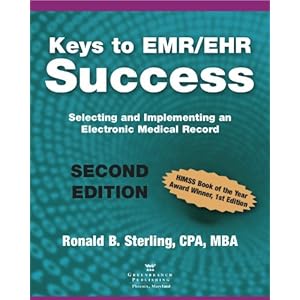

Presentation on Meaningful Use and EMR in Research
January 25, 2012
Last week I was invited to present to a medical school class on bioinformatics. My topic included EMR data standards, meaningful use and the use of EMR data in research. The session was very interactive and not totally captured in the slides. The challenge was presenting to medical students who are used to group activities, case studies and a research-based curriculum.
Year in Review – Travel
December 26, 2011
It was a big year for traveling to conferences:
- February – HIMSS Annual Conference in Orlando – spoke at the Social Media center twice and presented on a panel on social media
- March – AMIA Clinical Research Informatics Summit in San Francisco. Two podium presentations (CKD Registry and REDCap business model) and two posters
- April – attended TEDx Maastricht in the Netherlands and a side trip to UMC Radboud in Nimegen.
- April – ACRT meeting (Association for Clinical Research Training) in Washington, DC – panel presentation on REDCap.
- May – Patient Experience Summit at Cleveland Clinic with Enoch Choi presenting
- June – consulting at a hospital in Michigan on data warehousing
- September – Medicine 2.0 Congress in Palo Alto, CA. Poster presentation
- October – American Association of Medical Colleges meeting on Big Data in Washington, DC
- October – Clinical and Translational Science Awards Informatics meeting at the National Institutes of Health. Bethesda, MD – poster presentation
- October – Panel at Case Medical School, Cleveland on Social Media in Clinical Trials
- November – Senior Workers Conference in Minneapolis, MN – presentation on Social Media and Electronic Medical Records
- December – Center for Health Services Research and Policy at MetroHealth Medical Center, Cleveland, on Disease Registries using EMR Data
Distracted Doctors – Living in an App World
December 19, 2011
The NY Times article on how devices are distracting doctors certainly rings true as hospitals push patient safety and preventing data breaches. New devices, specifically smart phones and tablets (especially the iPad) are becoming pervasive in hospitals and outpatient settings often outside of the control of hospital IT departments. Medical schools as well attempt to increase awareness of the risks while evaluating the advantages of these devices.
One aspect of smart devices yet to be addressed is, does the app model in iOS and Android devices fit with medical practice. Part of the purpose of integrated EMRs is to bring all of the information to the user in one place. This increasingly includes CPOE and embedded clinical decision support tools. But an app model requires the user to jump from one app to another to acquire the information needed. This is a classic dilemma of an integrated application/portal (EMR) versus a better user experience (apps). Which works best for physician workflow? When will EMRs look more like apps?
Share this:
Presentation on Disease Registries using EMR data
December 10, 2011
On Dec. 2, I presented at the Center for Health Care Research and Policy at MetroHealth Medical Center on “Registry Using EMR Data: Chronic Kidney Disease Case Study.” This has been a successful registry which I am a coinvestigator on for the past 2 years. Some of the success factors include: a well-functioning interdisciplinary team, a systematic approach to the data, and a step-wise approach to publication and grant writing. It fits well into the IMO model of the Learning Healthcare System.
Slides are available here: http://www.chrp.org/seminars_past.asp
Share this: