
Posts Tagged ‘Google’
Glass in Medicine – Why There is Promise
August 19, 2013
In an interview on GlassStories, Kyle Samani gives the most cogent discussion of the pros and cons of Glass. He emphasizes that there is a cost to glass – not just financial but the fact that you have to wear them all the time while you have a fully functional smart phone in your pocket. So he sees limitations to the appeal to general consumers other than the geek coolness. However, on the enterprise side, especially in medicine, he sees real use cases. Specifically,
- physicians (and other healthcare providers) need their hands to work whether it is surgery or a physical exam
- physicians (and other healthcare providers) are mobile whether moving from one exam or hospital room to the next or traveling between care sites
- physicians (and other healthcare providers) are constantly interacting with people, either patients or colleagues
- physicians (and other healthcare providers) need to look things up, communicate with others
- physicians (and other healthcare providers) need to have clean hands – handling a mobile phone means transmitting germs, they need to wash their hands after each use even if they are using their mobile device at the bedside. The hands free commands in Glass enable them to avoid this
- he also thinks the privacy concerns are exaggerated – less deceptive than a mobile phone
Watch the full video interview.

Further Thoughts on Google Glass
July 10, 2013
Here are some major advantages:
- hands free browsing and video/photos
- lightweight and minimally intrusive
- can look at someone while browsing or during a hangout rather than looking down at a cell phone
- many possibilities for uses in healthcare and medicine – see this article from iMedicalApps. One additional thought – how about physicians receiving alerts on their patients’ lab results via Glass
- camera quality is excellent
Some downsides or challenges for developers to fix:
- dependent on open wireless networks or activating your phone as a personal hotspot ($$$$$)
- messages, searches and alerts limited to short text – considering the scale of the device, not sure how much more we can expect. If there is something that requires more detailed attention, we are at least alerted and can view it on a laptop
- especially in healthcare, privacy concerns since one can take an image of anyone without their permission. Maybe the device should have a small light indicating that a recording or photo is being taken
- If you are close to someone who also has Glass, their device might follow your verbal commands, “OK, Glass”. This actually occurred during my orientation
- Availability of prescription Glass
Most of these are easy to solve. The challenge is using this new technology in healthcare, developing apps, use cases and broader adoption.
Share this:Google Glass – Day 3 – Future Applications for Healthcare
July 9, 2013
On day 3, I brought Glass to work and introduced it to my staff and others at the hospital. Unfortunately, I could not connect to the internet thru Glass. The private wireless network did not allow a connection from the device and the public network requires browser authentication (like many airports and hotels) which is not possible in Glass. So the main demo was videos and photos I had already taken and demonstrating how to take photos and videos or having Glass read aloud alerts, such as, those from the New York Times.
So what applications are there for medicine and healthcare for this device? Already there are many ideas coming forward:
- “Google Glass makes some people uneasy, but a medical app that tells folks how to perform CPR not only could save lives, but also highlights what’s so awesome about our connected, sensor-rich future.”
- Google Glass Invades Social Media With #ThroughGlass
- Chloe Glass – a simulator wearing Glass to evaluate medical practice in training
- Use of Glass in surgery
- How Google Glass Is Changing Medical Education
- Glass on hospital rounds
Share this:
Google Glass – Day 1
July 7, 2013

Guest tag for Glass
Today I went
to Google New York to pick up Google Glass. I arrived at Chelsea Market in southern Manhattan. On the 8th floor is the headquarters for Glass on the east coast. We were issued guest tags The setting is loft-like with a small bar (we were offer drinks) and sat at one of several tall tables on stools with a mirror.

After an extensive orientation, I was ready to try them on my own.
Right next to the Chelsea Market is the Highline. Tired out photos and video which both worked well.

Highline
As I was warned that unless you are connected through the MyGlass website to an available wireless network or an open network that does not require authentication. The other alternatives is to connect through your phone’s bluetooth or better yet, enable your phone as a wireless hotspot, but that is an additional cost.
Later in the day, I was in Grand Central Station and took photos and videos from the balcony, aka, Apple Store.

Grand Central
Conclusion from Day 1 – There is a learning curve for Glass. managing the menu and voice commands. Learning to share photos is pretty straightforward. Adding apps like The New York Times can add a lot of content. Finding Twitter and Facebook deep in the menu can be a challenge. And remember, sharing photos or messaging are through Google+. Also, the Glass app is for Android devices only right now. So between the learning curve and the dependence on Google Apps means a change in orientation compared to managing apps through an iPhone. But the process is still interesting.
Does Glass have uses within healthcare? a growing number of users think so but it is up to the first 8000 Glass Explorers to determine its usefulness and prove that it is more than a toy.
Share this:
Book Review: The Googlization of Everything
August 27, 2011
This book by Siva Vaidhyanathan has the provocative subtitle “And why we should worry”, which defines the subtext of the book questioning whether the “Do no evil” search engine company has become something else as a result of its efforts to monetize everything. The book covers the broad domains that Google impacts modern life and discusses the predominant thinking driving the company – “faith in aptitude and technology” and infrastructure imperialism.”
The two pivotal chapters are “The Googlization of Knowledge” and “The Googlization of Memory”. The former deals primarily with the Google Book project and makes a point about the importance of preserving knowledge in the digital age, particularly preserving out-of-print books. But, the author cautions, should a for profit company hold such a public trust that has traditionally been held by public libraries. Similarly, in the latter, the author questions whether “Google is making use stupid” or not. Does consuming snippets of knowledge limit our ability to read for extended periods and reflect?And what impact does it have on education, particularly higher education? Both are valid questions and it may be that the way we think and consume information is changing. However, not all of this is due to Google as much as it is to social media and Wikipedia. Consumption of knowledge is becoming the ability to think critically about the volume of available information and not be controlled by the filters and overload of information. Understanding knowledge algorithms rather than being subservient to them is the key.
In conclusion, the author proposes a bold new project, The Human Knowledge Project, which appeals to the need to have more public control over knowledge through libraries and democratic processes rather than commercial interests. One might agree with him since the recent demise of Google Health. If Google Books are not profitable in 5-10 years, will this project also be abandoned leaving the legacy of digitalized books behind? Yet much of the books skepticism about Google and fears are overdrawn. Perhaps Google’s service to higher education through Gmail and other services will help it keep a commitment to educational and knowledge resources in the future.
This book by Siva Vaidhyanathan has the provocative subtitle “And why we should worry”, which defines the subtext of the book questioning whether the “Do no evil” search engine company has become something else as a result of its efforts to monetize everything. The book covers the broad domains that Google impacts modern life and discusses the predominant thinking driving the company – “faith in aptitude and technology” and infrastructure imperialism.”
The two pivotal chapters are “The Googlization of Knowledge” and “The Googlization of Memory”. The former deals primarily with the Google Book project and makes a point about the importance of preserving knowledge in the digital age, particularly preserving out-of-print books. But, the author cautions, should a for profit company hold such a public trust that has traditionally been held by public libraries. Similarly, in the latter, the author questions whether “Google is making use stupid” or not. Does consuming snippets of knowledge limit our ability to read for extended periods and reflect?And what impact does it have on education, particularly higher education? Both are valid questions and it may be that the way we think and consume information is changing. However, not all of this is due to Google as much as it is to social media and Wikipedia. Consumption of knowledge is becoming the ability to think critically about the volume of available information and not be controlled by the filters and overload of information. Understanding knowledge algorithms rather than being subservient to them is the key.
In conclusion, the author proposes a bold new project, The Human Knowledge Project, which appeals to the need to have more public control over knowledge through libraries and democratic processes rather than commercial interests. One might agree with him since the recent demise of Google Health. If Google Books are not profitable in 5-10 years, will this project also be abandoned leaving the legacy of digitalized books behind? Yet much of the books skepticism about Google and fears are overdrawn. Perhaps Google’s service to higher education through Gmail and other services will help it keep a commitment to educational and knowledge resources in the future.
Share this:More on Innovation – The Need for Actionable Ideas
May 25, 2011
An excellent post on Venture Valkyrie discusses why Innovation is not enough in healthcare. The author views that “there is no doubt that innovation is necessary to respond to the challenges of our current healthcare system” while “over-breeding of ideas that are innovative but not actionable.” It is important to consider innovation not just a good in itself, especially in healthcare where we are trying to impact personal health, as only good if it leads to real change. Some innovation will always fail, so the encouragement toward innovation should not have barriers that are too high, but realistic evaluation of these ideas, testing their viability, needs to occur.
Another note on innovation comes from the site udemy, a site which enables the creation of courses. Check out Ideas Come From Everywhere, a course by Marissa Mayer of Google, Inc. which she gave to Stanford Technology Ventures Program in 2006. It is certainly not dated and presents some of basic concepts of success through innovation that have made Google a success. Worth watching this short clips.
See this article from Forbes on Gladwell on Innovation: Truths & Confusions which tells a brief history of innovation but also distinguishes between innovators and creators but ends on a positive note that creators (who may come up with ideas but not successfully implement them) can become innovators.
Also posted at WikEhealth.
Share this:Book Review: Data Source Handbook
April 19, 2011
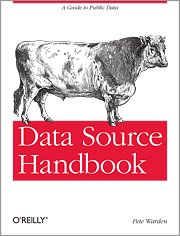 This new book from O’Reilly Media, written by a former Apple engineer, Pete Warden, is a catalog of code for connecting to publicly available APIs for all kinds of sites. It shows data sources by websites (whois, delicious), people by email (Amazon, FriendFeed), people by name (white pages, LinkedIn), search terms (Bing, Google), location (Google geocoding, US census), companies, IP addresses, books, films, music, products.
The brief reviews and code for each source includes those which use REST/JSON, YQL and other languages.
Overall the book is a very practical guide for programmers wanting to integrate public data into their websites or creating mashups. However, the book lacks any data sources related to health although many existing on the web from PubMed to ClinicalTrials.gov.
Share this:
Year in Review – Books of 2010
December 31, 2010
Following Kent Bottle’s lead in influential books in 2010, I decided to compose my own list:
- Chasing Medical Miracles The Promise and Perils of Clinical Trials. Tells it like it is – to be a participant in a clinical trial.
- Googled-The End of the World as We Know It – somewhat disappointing in that it discussed the advertising side of the business and less about the history of its technical evolution.
- DIYU: Epunks, Edupeneurs and the Coming Transformation of Higher Education. This book was recommended by a speaker at the J. Boye conference in Philadelphia. Questions the future viability of universities as they are undermined by Web 2.0 technology.
- Leading Geeks – Required reading for anyone who manages geeks, especially programmers. Helpful for anyone to understand the culture of geekdom, understanding the mindset of managing ambiguity and tearing down some stereotypes.
- The Singularity is Near by Ray Kurzweil – mind blowing futurism and undying optimism in technology even though this is from 2005 and 650 pages. The law of accelerating returns puts us on a fast track to the future. I am now following Kurweil’s Accelerating Intelligence blog.
- A Little Booklet About Health 2.0 – by Lucien Engelen. Brief but advancing health 2.0 concepts with a peak to the future from a European perspective.
- Long Tail: Why the Future of Business Is Selling Less of More – this lead to my blog post on Partnerships with Online Communities – The Long Tail, discussing some of the implications of the long tail in healthcare.
- The Collapse of Complex Societies – a venture into history and anthropology which I enjoy and blogged about: Declining Marginal Returns of Complexity
- Laugh, Sing and Eat Like a Pig by e-Patient Dave – a personal, signed gift from Dave himself when he visited Cleveland and had dinner with us.
- Connected for Health: The KP HealthConnect Story – Probably the best story of successful implementation of an EMR on a large scale basis with honest, realistic discussion of struggles and successes.
- Program or Be Programmed – Ten Commandments of the Digital Age – read appropriately as an ebook, makes some good points without being paranoid about technology’s growing role in our lives.
- The Bottom Billion: Why the Poorest Countries Are Failing and What Can be Done About It. Recommended by @Ciscoiii when visiting the World Bank in Washington, DC. Excellent analysis of failed states with recommendations at the UN level for solutions.
- Founding Faith: Providence, Politics, and the Birth of Religious Freedom – found this in Philadelphia at the Liberty Bell bookstore.
One on my shelf is Reading in the Brain: the New Science of How We Read.
More book reviews to come next year and many more will be on my Sony Reader.
Share this:Book Review: Googled-The End of the World as We Know It
February 27, 2010
I recently completed this book by Ken Auletta who promotes his unique access to the search engine giant. The books follow the history of Google from the earliest days of the founders at Stanford, to rocketing to fame, going public and then being labeled as the evil empire. More recently, he chronicles conflicts with the government, traditional media, traditional advertising, publishers and China. He leaves with Google at a crossroads of maturing founders which he suggests may be losing focus, competitors in social media, and ongoing challenges from Microsoft and others.
The book describes each new major app and the process and culture of building new tools and keeping them free. Only two pages are devoted to Google Health, however. Generally, the books focuses much more on the advertising business which has made lead to Google’s financial success sometimes overshadows description of apps and the engineering culture. Too many pages are devoted to the failing of traditional media and, of course, Google and the competition continue to evolve since the publication of the book.
The closing question in the book is: has Google become so big and entangled in conflict that it has lost its innovative edge? Recently the excitement over Google Wave and Buzz have met there match with Apple’s iPad. Yet the dominance of cloud computing and Google’s dominance in the cloud may continue to have more of a long term impact than the devices that connect to the cloud.
Share this:Google Scholar – A Personal Journey
September 26, 2009
The Krafty Librarian has taken on Google Scholar and discusses the good and bad of its search results from a medical librarian’s perspective. This led me on a vanity search of my own publications. Good news – by searching for “Sharp JW” & “Cleveland Clinic” most of my previous publications came up. What was interesting was to see citations. I had no idea how may articles and books used some of my publications. For instance, a search of “Sharp JW” & “Prostate Cancer” shows many citations in books especially from some of my quality of life and internet and cancer articles. Also came across an abstract on LVADs and quality of life I had forgotten about.
While there may be some limitations of Google Scholar, some of the features are a real plus.
Share this: