
Posts Tagged ‘Innovation’
Appropriate Use of Social Media in Healthcare Organizations
April 14, 2011
A question during a presentation on social media in healthcare about the appropriate use of social media in patient care areas. Social media can be an effective tool for engaging patients online. But what about the use of social media in patient care areas. Should nurses, physicians and other healthcare providers be online interacting with colleagues or family during active patient care? With busy clinics and busier hospital units and greater concern about patient safety, is there time for what administrators might view as a distraction? Would you want your nurse to be updating Facebook while you are waiting for post-op pain medication? Yet there may be some advantages to direct caregivers utilizing social media. How about the oncology nurse interacting with the cancer patient discharged last week? Or nurses within a hospital exchanging ideas about improving patient safety? Yet stories of abusive use of social media in health care persist.
Clear answers are hard to come by. Each hospital will need to develop its own policy and implementation of that policy in the use of social media in patient care environments. But when face time with the patient is the highest priority, social media may need to take a back seat.
Slides are here:
Share this:
TEDx Maastricht – The Future of Health
April 1, 2011
In anticipation of the International event on April 4, I wanted to share some links. Although many conferences which claim to be futurist meccas for healthcare, this one is bringing together a group of people including a very strong patient perspective which all are thinking innovation. Also, it is completely full and is being simulcasted to several countries.
- Website, speakers
- Some of the attendees via a tool which exploits LinkedIn
- mashup on VPRO
- Simulcast schedule – I am being interviewed at 11:15 local time
Follow tweets at #tedxmaastricht
Share this:Trends from Innovation and Entrepreneurship in the Healthcare Sector
March 24, 2011
One addition to my post on this book is the final chapter on trends – 20 in all.
- Hospitals are no longer buildings
- Patient Safety Focus
- Information is everywhere
- Evidenced-based Management
- Healthcare can’t keep up with the rate of scientific discovery
- “Not being sick” to “Being Well”
- Shortage of Professionals
- The information hight gains more and more influence
- Concepts such as P2P and Web 2.0 arrive at the health sector
- Social entrepreneurs take the lead
- Consumer-driven healthcare
- Electronic medical records
- Cost containment will become more and more critical in healthcare
- New actors will appear in the healthcare value chain
- Healthcare will become more and more “vertical”
- Personalize medicine drives the agenda
- Bioinformatics emerge
- Bioconnectivity is the next big thing
- Electronic signature is everywhere
- The triple helix is becoming real – administration, hospitals and universities, venture capital.
Some of these are obvious, others provocative. Are there more to add to the list?
Share this:Hearing Atul Gawande speak about Checklists and Health Policy
March 22, 2011
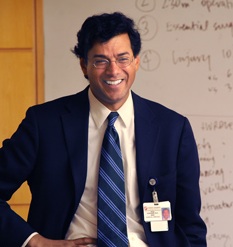
Atul Gawande
Just returned from live tweeting of Atul Gawande at Cleveland Clinic Ideas and full of quotes and ideas. For instance, the evidence is building for use of checklists showing significant reduction in mortality and complications so that he states that if there was a drug that showed this kind of effect it would be adopted immediately, even faster than Viagra. Gawande also discussed two of his well known New Yorker articles:
- The Cost Conundrum - What a Texas town can teach us about health care
- The Hot Spotters: Can we lower medical costs by giving the neediest patients better care?
In the end, he challenged the audience and the country to find one hospital which could reduce costs while not causing harm to set a model. He predicted that in the coming hospital wars, the ones which reduced cost while maintaining quality would win and others would lose (close).
Within the provocative statements was the voice of compassion and rediscovering the soul of medicine in the complex, competitive healthcare environment of today.
Check out the twitter feed from the meeting. And his book: The Checklist Manifesto and his checklists.
Final thought – why are hospitals not advertising that they endorse and complete adopt checklists? And why would anyone not have surgery in a hospital that does not use checklists? Why take the risk when the evidence is there?
Share this:
On the Bookshelf
February 13, 2011
While I read The Myths of Innovation as an eBook, my next three are all paperbacks:
- Reading in the Brain: The New Science of How We Read by Stanislas Dehaene
- Innovation and Entrepreneurship in the Healthcare Sector: From Idea to Funding to Launch by Luis G. Pareras, MD
- Keys to EMR/EHR Success: Selecting and Implementing an Electronic Medical Record by Ronald B. Sterling.
The last two are Greenbranch Publishing.
Watch for book reviews in the near future.
Share this:Innovation – Segway Style
February 2, 2011
Yesterday I attend the Cleveland Clinic Ideas for Tomorrow presentation by Dean Kamen inventor of the Segway and much more. His current company is called DEKA Research & Development Corporation and has several inventions to meet his goals of saving the planet and solving big problems with simple solutions. Many of these have implications for health but also he has created FIRST, an education initiative to help students become inventors and scientists. Perhaps more important that his inventions is the way that he thinks about innovation and invention. Part of this is within the mission of FIRST, “exciting mentor-based programs that build science, engineering and technology skills, that inspire innovation, and that foster well-rounded life capabilities including self-confidence, communication, and leadership.” He stated, “innovation is mostly about surprises” and lives his life expecting the unexpected. He complained about government regulation which inhibits innovation and has created his own country on an island off Connecticut as an act of rebellion. He scoffs at naysayers and believes in solving global problems. We need more of this in healthcare.
Share this:Using Social Media to Promote Evidence-Based Practice
January 17, 2011
This concept is unique in health care social media. It goes beyond marketing or even engaging customers and on to the real impact on practice. It happens that this may more of a Canadian approach to social media. Freed of much of the health care marketing in the US, tying evidence-based practice to social media goes to the heart of the value of these tools. Perhaps it is also the influence of Cochrane on evidenced based practice in Canada and the UK and EU.
On a side note, check out Spigit, a new company all about innovation. Not specific to health care but if you look toward Canada again to the Innovation Cell. See also this post from TechCrunch on visualization in innovation. More on innovation soon for a book review on The Myths of Innovation.
Share this:Year in Review – Books of 2010
December 31, 2010
Following Kent Bottle’s lead in influential books in 2010, I decided to compose my own list:
- Chasing Medical Miracles The Promise and Perils of Clinical Trials. Tells it like it is – to be a participant in a clinical trial.
- Googled-The End of the World as We Know It – somewhat disappointing in that it discussed the advertising side of the business and less about the history of its technical evolution.
- DIYU: Epunks, Edupeneurs and the Coming Transformation of Higher Education. This book was recommended by a speaker at the J. Boye conference in Philadelphia. Questions the future viability of universities as they are undermined by Web 2.0 technology.
- Leading Geeks – Required reading for anyone who manages geeks, especially programmers. Helpful for anyone to understand the culture of geekdom, understanding the mindset of managing ambiguity and tearing down some stereotypes.
- The Singularity is Near by Ray Kurzweil – mind blowing futurism and undying optimism in technology even though this is from 2005 and 650 pages. The law of accelerating returns puts us on a fast track to the future. I am now following Kurweil’s Accelerating Intelligence blog.
- A Little Booklet About Health 2.0 – by Lucien Engelen. Brief but advancing health 2.0 concepts with a peak to the future from a European perspective.
- Long Tail: Why the Future of Business Is Selling Less of More – this lead to my blog post on Partnerships with Online Communities – The Long Tail, discussing some of the implications of the long tail in healthcare.
- The Collapse of Complex Societies – a venture into history and anthropology which I enjoy and blogged about: Declining Marginal Returns of Complexity
- Laugh, Sing and Eat Like a Pig by e-Patient Dave – a personal, signed gift from Dave himself when he visited Cleveland and had dinner with us.
- Connected for Health: The KP HealthConnect Story – Probably the best story of successful implementation of an EMR on a large scale basis with honest, realistic discussion of struggles and successes.
- Program or Be Programmed – Ten Commandments of the Digital Age – read appropriately as an ebook, makes some good points without being paranoid about technology’s growing role in our lives.
- The Bottom Billion: Why the Poorest Countries Are Failing and What Can be Done About It. Recommended by @Ciscoiii when visiting the World Bank in Washington, DC. Excellent analysis of failed states with recommendations at the UN level for solutions.
- Founding Faith: Providence, Politics, and the Birth of Religious Freedom – found this in Philadelphia at the Liberty Bell bookstore.
One on my shelf is Reading in the Brain: the New Science of How We Read.
More book reviews to come next year and many more will be on my Sony Reader.
Share this:2010 Year in Review
December 24, 2010
It has been a year full of travel and accomplishments. Here is a month-by-month review:
- January – hosted Lucien Engelen and others from Radboud UMCN Hospital in the Netherlands at the Cleveland Clinic for two days on everything from the group practice model to innovation and patient experience in two days.
- February- vacation in Naples, Florida
- March – HIMSS 2010 in Atlanta presenting twice and AMIA Clinical Research Informatics Symposium presenting a poster. Also visited the Googleplex. Stopped in Salt Lake City for a day on the way home.
- April – Toronto for the - TAHSN Education Day for Healthcare Communicators – spoke on social media
- May - J. Boye Conference in Philadelphia – spoke on social media in healthcare and published my first article in iHealthbeat “Social Media in Health Care: Barriers and Future Trends”
- June – Visited Washington, DC. Vacation and some consulting
- July – Attended the Leadership Institute of the Group on Information Leadership of the American Association of Medical Colleges in La Jolla, California for a week and became a fellow.
- August – brief vacation in Salt Lake City including the Bonneville Salt Flats
- September – Named a fellow in the Healthcare Information and Management Systems Society and named in a NIH grant on Risk Calculators
- October – Presented at Toledo (Ohio) Hospital on social media and attended the CTSA Innovative Informatics for Clinical and Translational Researchers at the NIH. Did live tweeting while attending the Cleveland Clinic Innovation Summit.
- November – coauthor of an article on a disease registry in the Clinical Journal of the American Society of Nephrology and another prespectives piece in iHealthbeat on the secondary use of EMR data.
- December – Second article on the chronic kidney disease registry published. A positive editorial by a well known informaticists about the registry published
Looking forward to more in the coming year – conferences, presentations, publications.
Share this:Secondary Use of EMR Data
December 1, 2010
Part of the value of EMRs is the secondary use of the rich clinical data. Quality studies are an obvious win. This week, a new article by Kaiser Permanente Medical Group used this data in one of several registries to analyze 80,000 Total Joint and 5000 ACL Reconstruction Procedures in the Journal of Bone and Joint Surgery. The data was collected “through standardized documentation at the point of care” and “supplemented with existing administrative data from our electronic health records and other independent databases.” See the registry database structure here.
Also published this week is a second article from the Cleveland Clinic Chronic Kidney Disease Registry regarding the eGFR definition. This is another example utilizing these registries with secondary data for addressing significant issues in medicine.
The HIMSS 2011 conference will feature a symposium on secondary use of data as well.
Share this: